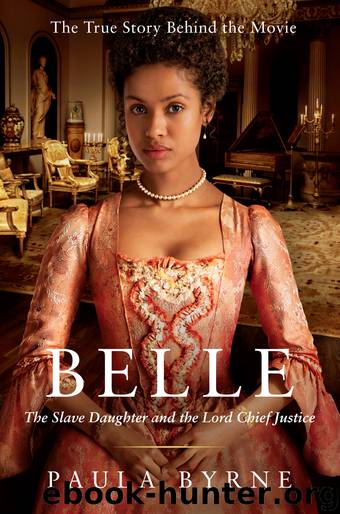
Belle by Paula Byrne
Author:Paula Byrne
Language: eng
Format: epub, mobi
Publisher: HarperCollins
Published: 2014-03-28T04:00:00+00:00
11
The Merchant of Liverpool
‘Am I not a man and a brother’: anti-slavery pendant designed by Josiah Wedgwood, now at Kenwood House
Throughout this large-built Town every Brick is cemented to its fellow Brick by the blood and sweat of Negroes.
William Bagshaw, 1787
The cold wind whipped across the River Mersey as young Billy Gregson set off to work as a rope-maker in the town of Liverpool. It may not have been the most glamorous of jobs, but it paid a wage, and rope-makers were very much in demand in a city of shipbuilders. Ships of all sizes lined the Mersey, most of them exporting coal, salt, lead, iron and textiles to Ireland, others carrying vast quantities of cheese to London.1 Billy walked past the Custom House, Blackburne’s saltworks and the glasshouses to reach the ropewalk. Ropewalks were harsh sweatshops, and frequently caught fire, as hemp dust forms an explosive mixture. It was back-breaking, dangerous work, but Billy had plans. One day he would own his own ropewalk, and be his own master.
Billy Gregson came from humble origins. His father John was a porter, but Billy would rise to become Mayor of Liverpool, and a wealthy merchant and banker. His sons would carry on his legacy. He loved Liverpool, and he never left. It was a place where you could escape your past and recreate yourself. Liverpool, with its mercantile, cosmopolitan edge, looked firmly to the future.
From its humble origins as a small fishing village, Liverpool had become a large, elegant Georgian town with fine streets and houses, looking out on the River Mersey. It was a booming, lively place, with grand shops, pleasure gardens and parks. It boasted sea baths and a tree-lined ‘Ladies’ Walk’. The Theatre Royal was one of the finest outside London. There were libraries, numerous coffee houses and drinking clubs. One visitor described it as ‘London in miniature’.2 A local guide called it the ‘first town in the kingdom in point of size and commercial importance, the metropolis excepted’.3
Perhaps the most impressive building in town was the new Liverpool Exchange, designed by John Wood, now Liverpool Town Hall. By the 1750s, Liverpool’s trade had burgeoned to such an extent that a new town hall was decided upon, both to accommodate the needs of its merchants and as a demonstration of their prosperity. It was to be the heart of the city, town hall, exchange and assembly rooms combined.4
The Exchange was a huge stone rectangular building constructed around a central courtyard surrounded by Doric colonnades. Most of the building was destroyed by a fire in 1795, and today it is surmounted by a large dome. The interior was multi-purpose, with commercial business on the ground floor, while the higher storeys housed the mayor’s office, courtrooms, council chambers and two elegant ballrooms and drawing rooms. A carved frieze on the exterior illustrates Liverpool’s trading routes and includes lions, crocodiles, elephants. But in the centre of the frieze is a chilling reminder of Liverpool’s guilty past. There, set in stone, alongside the exotic animals, are African faces.
Download
This site does not store any files on its server. We only index and link to content provided by other sites. Please contact the content providers to delete copyright contents if any and email us, we'll remove relevant links or contents immediately.
Cecilia; Or, Memoirs of an Heiress — Volume 2 by Fanny Burney(31962)
Cecilia; Or, Memoirs of an Heiress — Volume 3 by Fanny Burney(31945)
Fanny Burney by Claire Harman(26608)
We're Going to Need More Wine by Gabrielle Union(19055)
Plagued by Fire by Paul Hendrickson(17417)
All the Missing Girls by Megan Miranda(16053)
Cat's cradle by Kurt Vonnegut(15365)
For the Love of Europe by Rick Steves(14180)
Bombshells: Glamour Girls of a Lifetime by Sullivan Steve(14082)
Leonardo da Vinci by Walter Isaacson(13342)
4 3 2 1: A Novel by Paul Auster(12405)
The remains of the day by Kazuo Ishiguro(9006)
Adultolescence by Gabbie Hanna(8931)
Note to Self by Connor Franta(7673)
Diary of a Player by Brad Paisley(7588)
Giovanni's Room by James Baldwin(7354)
What Does This Button Do? by Bruce Dickinson(6210)
Ego Is the Enemy by Ryan Holiday(5456)
Born a Crime by Trevor Noah(5385)
